
When a gutter begins leaking, repairing the problem often seems like the most economical solution. However, depending on the age, condition, and layout of the existing gutters, replacing the affected sections — or even the entire system — may provide significantly better long-term value.
At Tri-City Seamless Gutter Systems, we believe homeowners should understand their options before investing in a gutter repair.
Option 1: Replacing a Leaking Box Miter
One of the most common gutter leaks occurs at a box miter, the corner component connecting two sections of gutter.
Replacing a box miter may sound simple, but the process can be surprisingly labor-intensive.
The existing corner must be carefully separated from the adjoining gutters, which may involve removing multiple fasteners and layers of old sealant. The remaining sealant must then be scraped away, and the existing gutter surfaces cleaned and prepared for the new connection.
This is often the most challenging part of the repair. Old sealant can be difficult to remove completely, and years of oxidation can affect how well new sealant bonds to the existing aluminum.
Any remaining residue, damaged metal, or uneven surfaces can create weak points that increase the possibility of future leaks.
Although relatively little new material is needed, the repair still requires a service visit, equipment, and labor.
Our minimum service charge is $250, which would apply to a typical single box miter replacement.
This can be a reasonable option when the surrounding gutters are relatively new and in excellent condition.
Is the Leaking Corner Really the Problem?
Another factor to consider when dealing with a leaking miter is the pitch of the existing gutters.
Gutters should be installed with proper drainage toward the downspouts. However, improper pitch or a low spot near a corner can cause water to collect and remain in the miter rather than draining away.
When water consistently pools in a corner, it places prolonged stress on the sealed connections. Even a small weakness in the sealant can eventually allow water to escape.
Simply replacing the leaking miter may temporarily solve the problem, but if the underlying drainage issue isn’t corrected, the new corner could develop the same problem over time.
Properly pitched gutters allow water to drain away from the corner, reducing the amount of time water sits against the sealed connections. Although any corner can develop a leak, eliminating standing water can significantly reduce the likelihood of recurring problems.
This is another reason replacing the adjoining gutter sections may be the better long-term solution. A new installation allows us to evaluate and correct the pitch, eliminate low spots where possible, and install a new corner using clean materials and properly sealed connections.
Sometimes the best way to fix a leaking corner isn’t simply to replace the corner. It’s to correct the conditions that caused it to leak in the first place.
Option 2: Replacing the Miter and Adjacent Gutters
In some situations, replacing the leaking corner along with the gutter sections attached to it makes considerably more financial sense.
Rather than spending time carefully separating the old corner and removing years of sealant, we can remove the affected gutter sections and install new seamless gutters using clean, properly prepared materials.
This also allows us to install our preferred strip miter, which has fewer seams to seal than a traditional box miter.
The homeowner receives new gutters, hangers, sealant, and corner components, resulting in a clean, attractive installation that we can confidently stand behind.
A Real-World Cost Comparison
Consider a recent estimate we provided to a homeowner with a leaking box miter.
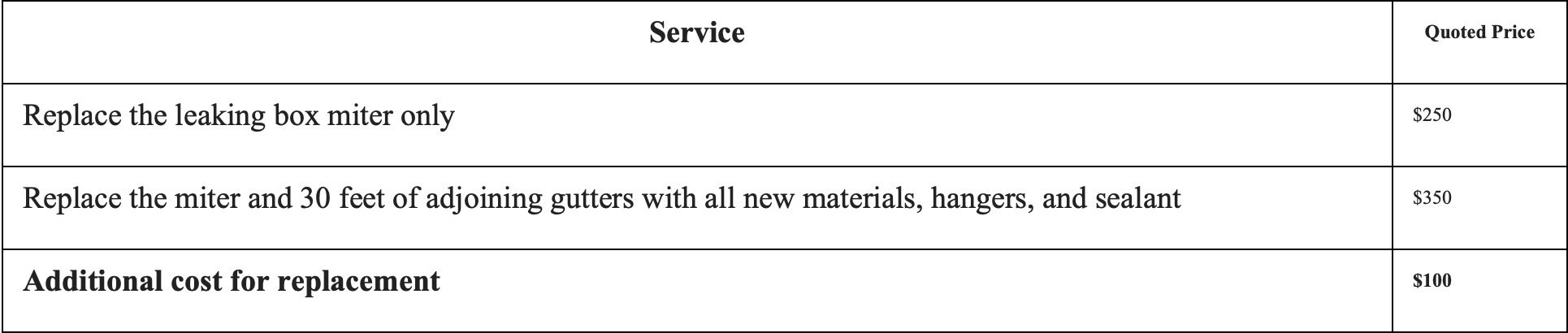
For just $100 more, this homeowner could replace 30 feet of aging gutters rather than simply repair one leaking corner.
The price difference isn’t always this small. The length of the adjoining gutters, accessibility, and how the affected sections connect to the rest of the home all influence the cost.
However, this example demonstrates why comparing repair and replacement options is worthwhile.
Why Isn’t the Price Difference Greater?
The cost of gutter work involves more than materials alone.
Travel, equipment, setup, labor, and cleanup all contribute to the final price.
When replacing a leaking box miter, considerable time may be spent removing the old corner, scraping away existing sealant, and preparing aging gutter surfaces for a new connection.
Even with careful preparation, there’s uncertainty when working with older materials. Oxidation, residual sealant, or damage from disassembly can compromise the reliability of the new seal.
Replacing the adjacent gutter sections eliminates much of this preparation work. Although more material is required, the installation itself can be more straightforward.
In certain situations, the additional material cost is relatively small compared with the labor already involved in making the repair.
Is Replacement Always the Better Choice?
Not necessarily.
If the existing gutters are relatively new, structurally sound, properly pitched, and otherwise functioning as intended, replacing a leaking miter may be the most practical option.
The length and layout of the gutter system also matter. Replacing a corner attached to two long gutter runs may be significantly more expensive than repairing the existing connection.
However, when the affected gutters are older, relatively short, or isolated from the rest of the system, replacement may offer substantially better value.
Every home is different, which is why we evaluate the existing system before recommending either option.
Or Is It Time to Replace Your Entire Gutter System?
A typical aluminum gutter system can last approximately 20–25 years, depending on the quality of the materials, installation, and maintenance.
As gutters age, sealants begin to deteriorate, and years of expansion and contraction through Michigan’s changing seasons can take their toll on corners and end caps.
If you’re beginning to experience leaks at multiple corners or end caps, it may be a sign that your gutter system is approaching the end of its useful life.
While individual repairs may temporarily resolve these problems, continuing to invest in an aging system can become expensive, especially when each repair requires another service visit.
At some point, replacing the entire system may be more economical than repeatedly repairing individual leaks.
A complete replacement provides new gutters, corners, hangers, and sealant throughout the home, along with a clean, uniform appearance.
Of course, age alone doesn’t determine whether gutters need replacement. A properly installed and maintained system may last considerably longer than 25 years.
Our Approach at Tri-City Seamless Gutter Systems
After years of working with different gutter systems and manufacturers’ components, we’ve developed installation methods and selected materials that have proven reliable over time.
We understand that every homeowner has different priorities and budgets. Our goal is to explain the available options, the costs involved, and the advantages and limitations of each.
Sometimes repairing a leaking corner makes perfect sense. Other times, replacing the affected sections — or the entire system — is a better long-term investment.
For details about our warranty coverage, please see the warranty section of our website.
The important question isn’t always whether your gutters can be repaired. It’s whether repairing them is still a worthwhile investment.
The pricing example above reflects an actual estimate and is provided for comparison purposes. Costs vary based on the layout, condition, and accessibility of each gutter system.